Rooks FTF Values 2026: Rook Value Checks & Trade Guide
Understand rook, rooks, and common misspelling searches, then verify the exact FTF item, demand, stability, and full trade before accepting.
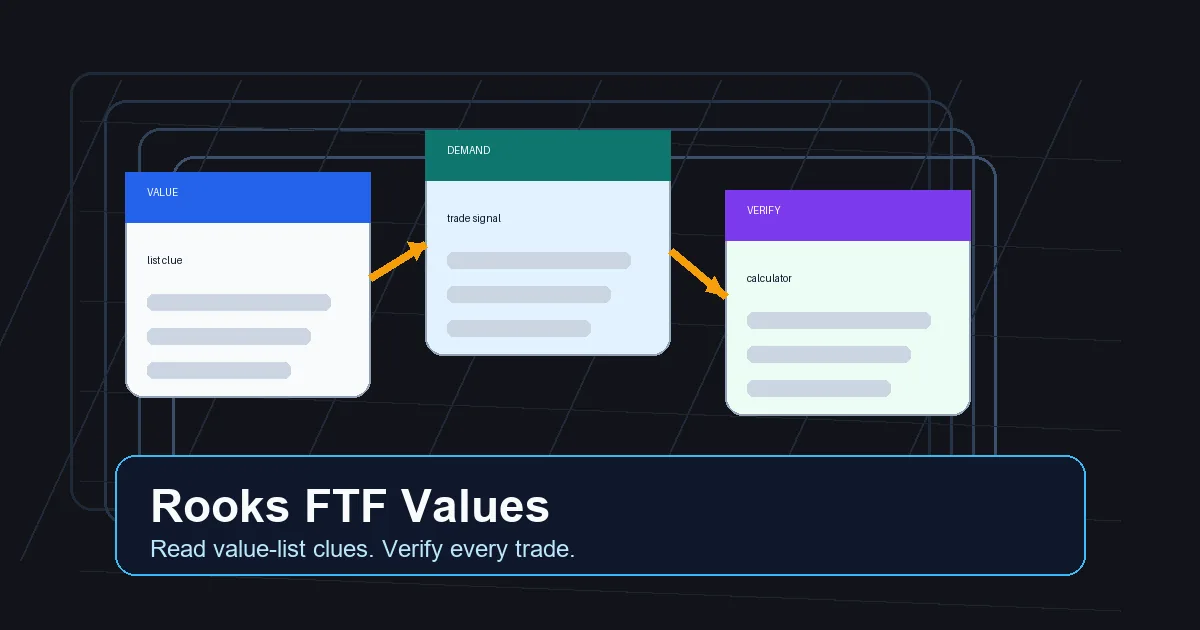
If you search for Rooks FTF values, ftf rooks values, rook FTF values, or even rock FTF values, you are probably looking for a fast way to judge a Flee the Facility trade. Players often search these phrases when they see a community value list, a screenshot, a trade offer, or a Discord comment that uses short labels without explaining how to verify the numbers.
The important point is that FTF values are community references, not official Roblox prices. A value list can help you understand approximate worth, but a safe trade check also needs demand, stability, item type, set context, and the exact items on both sides of the offer.
This page explains how to use Rooks-style value searches without overtrusting them. It does not replace the full FTF Values 2026 guide or the live FTF Calculator. Instead, it shows how to move from a value-list clue to a practical win, fair, or lose decision.
Quick Answer
Searches such as rook FTF values, rooks FTF values, and even rock FTF values can point to the same user need, but not always the same item. Confirm the exact name first, then compare value, demand, stability, and the complete offer.
What Does Rooks FTF Values Mean?
Rooks FTF values usually refers to a community value-list style search for Flee the Facility trading values. Some players type it as rook FTF values, rooks values, or rock FTF values. In search behavior, these phrases often share one intent: finding a value reference before trading hammers, gemstones, or full sets.
Because the phrase is not an official Roblox or Flee the Facility term, it can be messy. A player may be referring to a specific value-list source, a copied spreadsheet, a community nickname, or a misspelled search for an item/value page. That is why the source matters less than the verification process.
A reliable check should answer four questions: what item is being traded, what current value does the item have, how strong is demand, and does the calculator result match the value-list claim? If any of those answers are missing, the trade is not ready to accept.
How to Read a Rooks FTF Value List
Most Flee the Facility value lists use similar ideas even when they display them differently. Read the label, then check what it means in real trades.
| Term | What it means | How to use it |
|---|---|---|
| Value | The approximate community reference for an item. | Use it as a starting number, then check demand. |
| Demand | How many players actively want the item. | High demand usually makes an item easier to trade later. |
| Stability | Whether the item is rising, stable, dropping, or uncertain. | Avoid treating unstable values like fixed prices. |
| Set context | Whether an item pairs with a matching hammer or gemstone. | Check if splitting a set makes the offer weaker. |
| FV / trade value | A community shorthand for comparing Flee the Facility items. | Make sure the list explains its unit before trusting the result. |
How to Verify Rooks FTF Values Before Trading
Use this process when a player sends you a Rooks value claim, a rock/rook typo search result, or a screenshot that says an item is worth a certain amount.
-
Identify the exact item name
Confirm whether the item is a hammer, gemstone, set piece, event item, or another tradeable cosmetic. Do not rely on abbreviated names when high-value items are involved. -
Check the current FTF value reference
Open the FTF Values 2026 page or value-list guide and compare the item against the latest context, not an old screenshot. -
Compare demand and stability
A listed value is weaker when demand is low, unstable, or dropping. A slightly lower value item can be better if it is easier to trade again. -
Enter both sides into the calculator
Use the FTF Calculator for the complete offer. Bulk trades, mixed hammers/gems, and set splits are easy to misjudge by eye. -
Pause if the offer depends on pressure
If the other player rushes you, changes items late, or says a list proves the trade without context, treat that as a risk signal.
Need a direct trade check?
Open the FTF Calculator and compare both sides before accepting the trade.
Verify with the FTF CalculatorRooks FTF Value Check Examples
These examples show how a value-list claim can change after demand and trade context are checked.
| Scenario | Value-list claim | Safer check |
|---|---|---|
| One item is called rare | The other player says rarity makes it a win. | Check demand and calculator totals; rarity alone is not enough. |
| A screenshot shows a high value | The listed number looks profitable. | Verify date, item name, and whether the value is still stable. |
| Several low-demand items are offered | The total number seems higher. | Run the full offer through the calculator and consider liquidity. |
| A set piece is being split | Each item looks fair by itself. | Check whether the complete set has extra collector demand. |
Common Mistakes With Rooks, Rook, and Rock FTF Values
The biggest problems come from treating a search phrase as proof instead of checking the actual trade.
- Accepting a trade because someone shows a cropped value-list screenshot without date, source, or demand context.
- Confusing similarly named hammers, gemstones, or set items because the trade uses a short nickname.
- Assuming a high listed value means high liquidity. Some rare items are hard to trade even when the number looks strong.
- Ignoring set context. A hammer and gemstone may trade differently together than they do separately.
- Using an old Rooks-style value reference after an event, update, or community demand shift.
Related FTF Value Pages to Use Next
If your search is broad, start with the full FTF Values 2026 guide. It explains overall value logic across hammers, gemstones, rarity, demand, and fair trade checks.
If you already know the item type, use the focused hammer or gemstone guide. If you only need a verdict for a specific offer, use the W/F/L calculator page or the calculator on the homepage.
Rooks FTF Values FAQ
Bottom Line
Rooks FTF values searches are useful when they help you find a starting value, but they should never be the only reason you accept a trade. The safer workflow is simple: identify the item, check the current value reference, compare demand, then run the whole offer through the FTF Calculator.
That process protects you from outdated lists, misspellings, cropped screenshots, and pressure trades while still letting you use community value data quickly.
Useful References
Last updated: July 10, 2026