FTF Set Values 2026: Complete Set Worth & Trading Guide
A practical Flee the Facility set value guide for players comparing hammer-and-gemstone pairs, bundle premiums, split trades, and W/F/L calculator results.
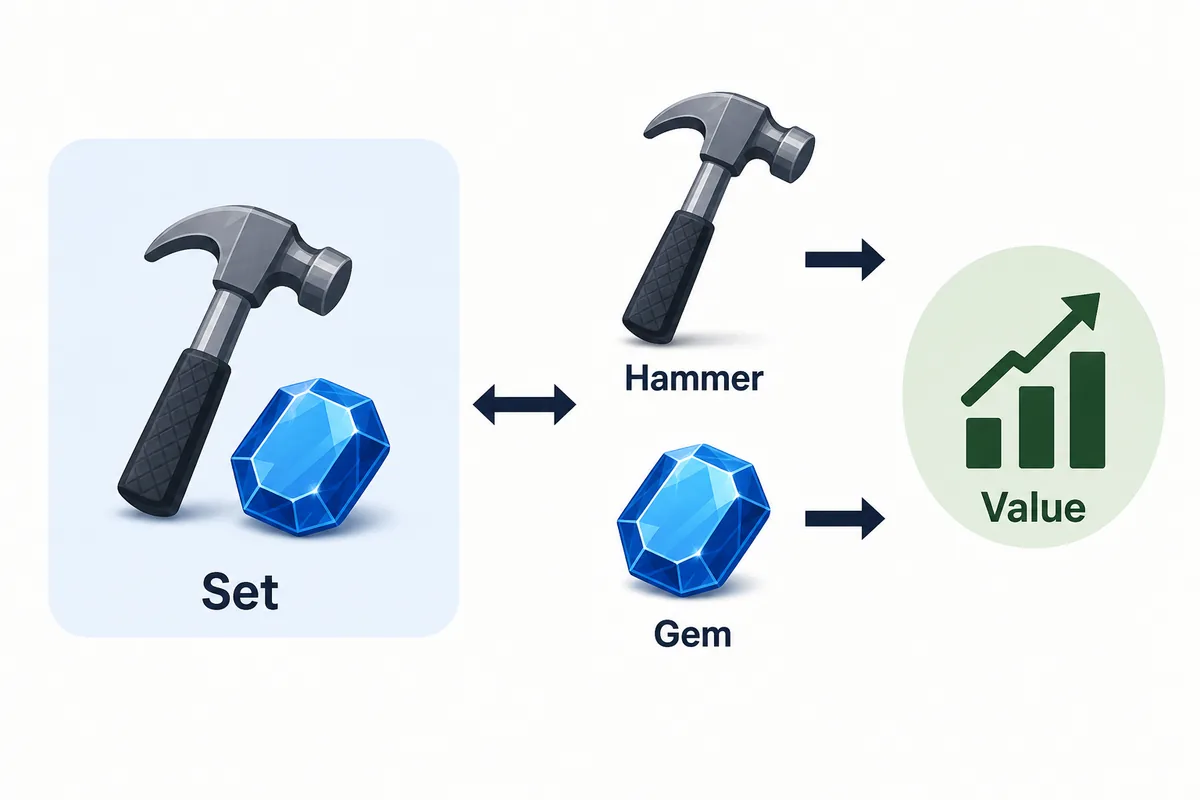
If you are searching for FTF set values, you are usually trying to decide whether a Flee the Facility hammer and gemstone pair should be traded as one complete set or valued as two separate items.
The short answer is that a set can be worth more than the two pieces only when the pair has real collector demand. If the matching hammer is popular but the gem is weak, or if one side is dropping, the set premium can disappear quickly.
Use this guide with the full FTF Values 2026 page and the FTF Calculator. The article explains the logic behind set value, while the calculator helps you judge the exact offer before you accept.
Quick Answer
FTF set values should be checked as both a complete bundle and as separate hammer plus gemstone values. Keep the set together when collector demand is active; split it when separate demand or calculator totals make the trade safer.
What Are FTF Set Values?
FTF set values are community references for complete Flee the Facility item pairs, usually a hammer and its matching gemstone. Players use them when a trade involves a full themed pair rather than one isolated item.
A set value is useful because some collectors prefer owning the complete match. That can make a clean set easier to present in a trade than a random mix of hammers and gems. However, set value is still community-driven and can change when demand shifts.
The safest way to read a set is to check three views: the complete set value, the hammer value by itself, and the gemstone value by itself. If the complete set offer is only fair because of a weak premium, be careful before overpaying.
What Makes a Flee the Facility Set Valuable?
Set value comes from more than rarity. These signals explain when a hammer-and-gemstone pair deserves attention in real trades.
| Set signal | Why it matters | Trade check |
|---|---|---|
| Matched pair | A complete hammer and gemstone pair is easier for collectors to understand. | Check whether both pieces are the real matching items. |
| Demand | A set only deserves extra value when players actively want the pair. | Prefer sets with steady offers, not only high listed numbers. |
| Split liquidity | Some sets are harder to sell complete than as two separate items. | Compare the set offer with the hammer-only and gem-only demand. |
| Rarity source | Event or limited sets can have capped supply. | Verify whether the items still enter the game or came from an old event. |
| Stability | A set can drop if one piece loses demand. | Avoid paying a premium when either side is unstable or falling. |
| Trade size | Large set trades can hide small losses in bundles. | Run the full offer through the calculator before accepting. |
FTF Set Value vs Split Value
The main set-value question is whether the pair should stay together. A complete set can feel cleaner, but the market may still value the hammer and gem separately if collectors are not actively chasing the pair.
Before accepting a set trade, compare the bundle against its split value. If the hammer and gemstone would be easier to trade one by one, do not pay a large premium just because the items match.
| Situation | Keep as a set | Split into pieces |
|---|---|---|
| Collector demand is active | Usually better, because the pair is the selling point. | Only split if the separate offers are clearly stronger. |
| One piece has weak demand | Risky, because the set may be harder to move. | Often safer if the strong piece can trade independently. |
| You need small adds | May be too bulky for a precise trade. | Useful when the gem or hammer balances a smaller offer. |
| Values are volatile | Wait or negotiate lower; premiums can disappear quickly. | Check each item separately and avoid overpaying for hype. |
| Both pieces are stable | Reasonable if the combined offer is fair. | Also reasonable if you need liquidity more than collection appeal. |
How to Check If a Set Trade Is Fair
Use this workflow when a trade includes a complete set, a partial set, or a player claims that the pair has extra value.
-
Confirm the matching pair
Check the exact hammer and gemstone names. Do not assume two themed items are a real set without verifying the pair. -
Check both separate values
Look up the hammer and gem individually on the value list so you know the baseline before any premium. -
Check complete-set demand
A set premium is only useful if traders currently ask for the pair and not just one item. -
Compare stability
If one side is unstable or dropping, the complete set can become harder to trade later. -
Run the full offer through the calculator
Enter every item on both sides, including adds, then use the result as the final W/F/L check.
Need to judge a set offer now?
Open the FTF Calculator, enter both sides, and compare the W/F/L result with demand and set context.
Check the Set TradeFTF Set Trade Examples
These examples show why set value should be checked with demand and calculator totals, not by item count alone.
| Scenario | What players often assume | Better decision |
|---|---|---|
| Complete set for several random items | More items means the bundle is better. | Compare total value, demand, and whether the random items are easy to trade. |
| Matching hammer and gem are offered together | The set always deserves a premium. | Premium only makes sense if collectors currently want that pair. |
| A set is split for one high-demand hammer | Splitting is always a loss. | It can be fine when the new hammer is more liquid and the calculator result is fair. |
| Event set after a demand spike | The price will keep rising. | Check stability first; recent hype can reverse after offers slow down. |
| One side includes small adds | Adds make the trade safe. | Small adds rarely fix a weak core item. Judge the main set first. |
Common FTF Set Value Mistakes
Avoid these mistakes when trading complete sets or splitting a hammer-and-gemstone pair.
- Assuming every matching hammer and gemstone pair deserves a premium.
- Ignoring the separate value of each item before judging the bundle.
- Overpaying for a set when only one piece has strong demand.
- Treating old screenshots as current set value proof.
- Forgetting that several low-demand adds may not make a set trade fair.
- Splitting a desirable set without checking whether collectors still want the pair.
- Accepting pressure trades because the other player says the set is rare.
FTF Set Values FAQ
Final Thoughts
FTF set values are helpful when a trade involves a complete hammer-and-gemstone pair, but the set label should never replace demand and calculator checks.
Keep a set together when the pair has active collector demand and stable value. Split or negotiate lower when the separate pieces are easier to trade, one side is weak, or the premium is based only on hype.
References
Last updated: June 10, 2026