Flee the Facility Beast Guide: Patrol, Chase & Capture
A practical round-by-round plan for reading signals, choosing useful patrols, making deliberate chase decisions, and returning to unfinished objectives.
How to Play as Beast in Flee the Facility
A useful Flee the Facility Beast guide follows one loop: read the newest signal, choose a short route toward unfinished objectives, commit to a chase only while it creates control, then return to the round. A capture matters, but so does time spent away from other players and computers.
Do not wait at one Freeze Pod: the developer rules list camping as an offense. Pressure routes and objectives, then update your plan when new information arrives.
Scope: This guide covers general Beast decisions, not guaranteed routes, every room, or current map data.
How to Play the Beast Role in Flee the Facility
The Beast must create pressure without spending the round on one person. Computers, rescues, movement, and escape progress compete for attention. Weigh what is happening now against what other players may do next.
Work in short cycles: scan, choose a route, check for progress, then reset. If the trail goes cold or travel becomes costly, leave; a fresh signal is more useful than another sweep of an empty room.
Read the Round Before You Choose a Patrol
Treat signals as clues, not coordinates. A failed computer check may point to a broad area; movement or a rescue shows the round has shifted. Prefer fresh information over an older route plan.
Before moving, ask which objective is unfinished, how to reach it without crossing the map, and what other players may do while you are away. This prevents chasing a sound after its opportunity has passed.
A computer mistake
Use a failed check as a direction clue. Approach the likely area, then listen or look for fresh evidence before committing to a long sweep.
A rescue
A rescue changes both the pod and the objective picture. Decide whether a nearby route can pressure the rescuer without leaving several computers unattended.
A player disappears from view
Do not assume the player stayed in the last room. Check the next connection they could reasonably take and protect your own return path.
No clear signal
Use the quiet moment to visit a compact loop of unfinished objectives. Avoid crossing the map repeatedly without a fresh reason.
Patrol Unfinished Objectives Without Aimless Loops
Cover two nearby reasons to move, such as an unfinished computer and a likely rescue path. On a large map, choose a zone and its connection; on a compact map, watch the doorway between objectives instead of standing in one room.
Use an out-and-back route. If the first area is quiet, check the next likely objective and return by another connection when possible. Keep routes that reveal information or shorten response time; repeated empty sweeps make movement predictable.
- Name the nearest unfinished objective or the freshest signal.
- Choose a short route that covers a second relevant connection.
- Look for a new cue before entering an isolated room.
- If the area is empty, continue to the next useful check instead of circling back immediately.
- Reassess after a rescue, completed computer, or lost chase.
- Keep enough time and distance to respond to a different objective.
Turn a Chase Into a Route Decision
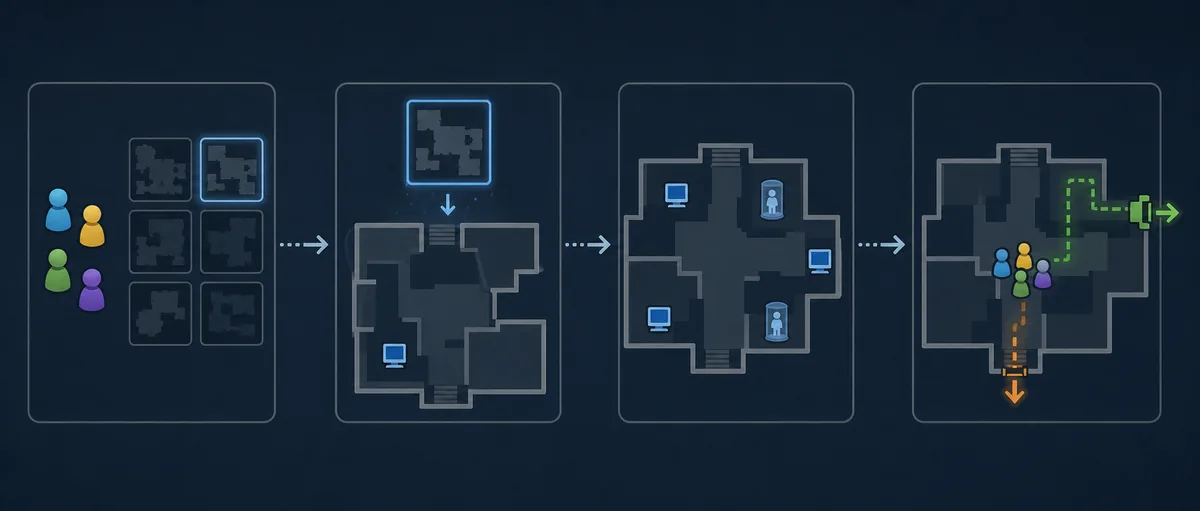
When you spot a Survivor, notice the doorway, window, vent, or turn that could change the route. Move toward the connection they may need next; limit easy choices instead of copying every turn.
Keep objectives, rescues, and other players in view. If sight breaks, use the last reliable direction to check one nearby exit. Do not turn an uncertain clue into a map-wide sweep.
- Before committing: Ask whether this route keeps you near a useful objective or whether it sends you across the map for one uncertain target.
- At a fork: Watch the connection with fewer safe exits, but leave room to respond if the Survivor takes another route.
- After losing sight: Check the nearest plausible exit or hiding route once. If no fresh information appears, return to the patrol loop.
- After a hit: Recheck the round state. Do not assume every follow-up is worth more than pressure on unfinished objectives.

Secure a Capture, Then Rejoin the Round
A capture may prompt a rescue. Use a nearby Freeze Pod when practical, then choose what to watch next: the rescue route, an active computer, or the latest signal. Keep moving instead of treating the pod as a stopping point.
Avoid waiting beside a captured player; the developer rules list camping as an offense. When you leave, note the likely rescue route and keep enough distance to respond to fresh activity.
After a rescue, reassess both players. The rescuer and rescued player may take different routes, so follow the one that best connects to current objectives.
Adjust When Computers Are Nearly Done
As objectives fall, empty patrols cost more. Watch routes between remaining work and the exits. When the last computer completes, shift from early-round patrols to exit timing and approach routes.
Do not wait at one gate without evidence. Read which exit is more likely while preserving a route to the other; reposition when movement or a confirmed signal changes the picture.
- One computer remains. Shorten the patrol and revisit the routes that lead to that objective.
- A rescue is likely. Watch the connection between the pod and the most useful unfinished objective rather than waiting at the pod.
- Exits are active. Use sound and visible movement to choose a gate, while keeping a plausible return route to the other exit.
Flee the Facility Beast Strategy by Situation
Use these as starting decisions. Room geometry, player choices, and current game behavior can change what is useful in a particular round.
| Situation | First decision | Recheck when |
|---|---|---|
| Fresh computer error | Move toward the likely zone and confirm with another cue. | The area is quiet or another objective becomes more urgent. |
| Long chase across the map | Look for a cut-off route and set a time to abandon the trail. | Sight is lost and the likely exits have already been checked. |
| A player is captured | Select a nearby pod and plan the next patrol connection. | A rescue, new signal, or computer completion changes the round. |
| No active cue | Check a short loop between unfinished objectives. | The loop repeats without showing new activity. |
| Endgame | Watch objective-to-exit connections and preserve a second route. | Fresh movement confirms a different approach. |
Common Beast Mistakes to Avoid
Good Beast play is mostly about updating decisions. These habits make the next signal harder to use.
- Chasing every player to the map edge. A distant chase can leave useful objectives open. Set a clear reason to continue, then return when that reason ends.
- Repeating one patrol without checking progress. A route that found nothing once may not deserve another lap. Change zones when the information is stale.
- Waiting beside one pod or exit. Camping is listed in the developer rules as an offense. Use route pressure instead of staying parked.
- Treating a community blueprint as a live map. Use diagrams for orientation only. Confirm current doors, rooms, and active objectives in the round.
- Calling a route guaranteed. A tactic is a choice under uncertainty. Player skill, map layout, and new information can change the result.
Fair Play and the Limits of This Guide
This article covers ordinary play and does not recommend exploits, teaming, alternate-account spectating, or third-party tools. For policy questions, use the developer's current rules rather than a strategy summary.
The rules page fetched for this guide is dated August 20, 2026 and lists camping as an offense; wording and enforcement may change.
Flee the Facility Beast Guide FAQ
Flee the Facility Beast Guide Summary
Read fresh signals, patrol useful objective connections, and reassess after a chase, capture, rescue, or computer completion. Keep community maps as orientation, avoid camping, and change routes when the live round changes.
Official Sources and Editorial Notes
- Flee the Facility on Roblox: Official game listing and description of the run, hide, and escape premise.
- Flee the Facility Game Rules: Developer forum rules page; the fetched version is marked August 20, 2026 and lists camping as a gameplay offense.